
Your MRO platform manages the whole operation. The airframe’s structural history deserves a tool built for exactly that job.
Most maintenance organizations that run AMOS have made a sound decision. It is one of the most capable MRO platforms in service, holding engineering, planning and logistics together in a single source of truth, at the scale a modern airline needs. None of what follows is an argument against it.
There is, however, one discipline where a broad MRO module and a purpose-built tool are simply not doing the same work: the management of structural damage. The dents, buckles, scratches and repairs that accumulate across an airframe’s twenty-five-year life are not routine line items. They are the record an auditor, a lessor or an airworthiness inspector will read closely, line by line, and they are the record most likely to cost you time when it is incomplete.
A living record, only as good as the moment it is captured
That is the gap Dent & Buckle is built to close. Not by replacing AMOS, but by giving the structural side of your operation the depth and speed it has always deserved. When integrated with AMOS, structural records captured in Dent & Buckle become available within your wider MRO environment—and vice versa.
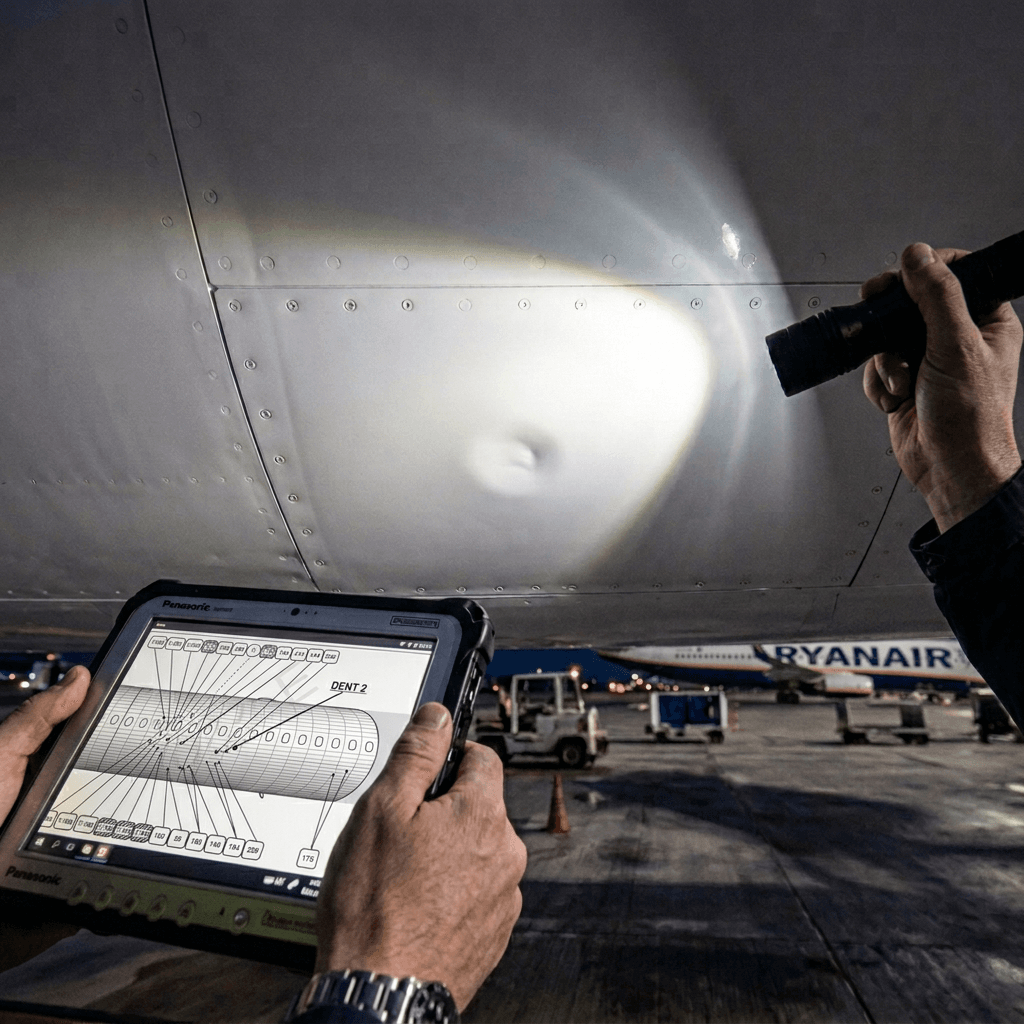
A dent and buckle chart is not a form you complete once. It is a living document that grows with the aircraft, evidence that every structural issue has been found, assessed and, where required, repaired. Its entire purpose is to demonstrate continued airworthiness.
The difficulty lies in how that record is created. Assessments on an operational aircraft happen under time pressure, often on the ramp, and the standard required for a lease return or an airworthiness inspection is frequently not met on the first attempt. The result is familiar to every CAMO: re-assessment, duplicated effort and cost that should never have been incurred. A general MRO field can confirm that a damage exists. A specialist tool changes how accurately and how quickly it is captured in the first place, and that is where the saving begins.
What a dedicated dent and buckle system actually adds
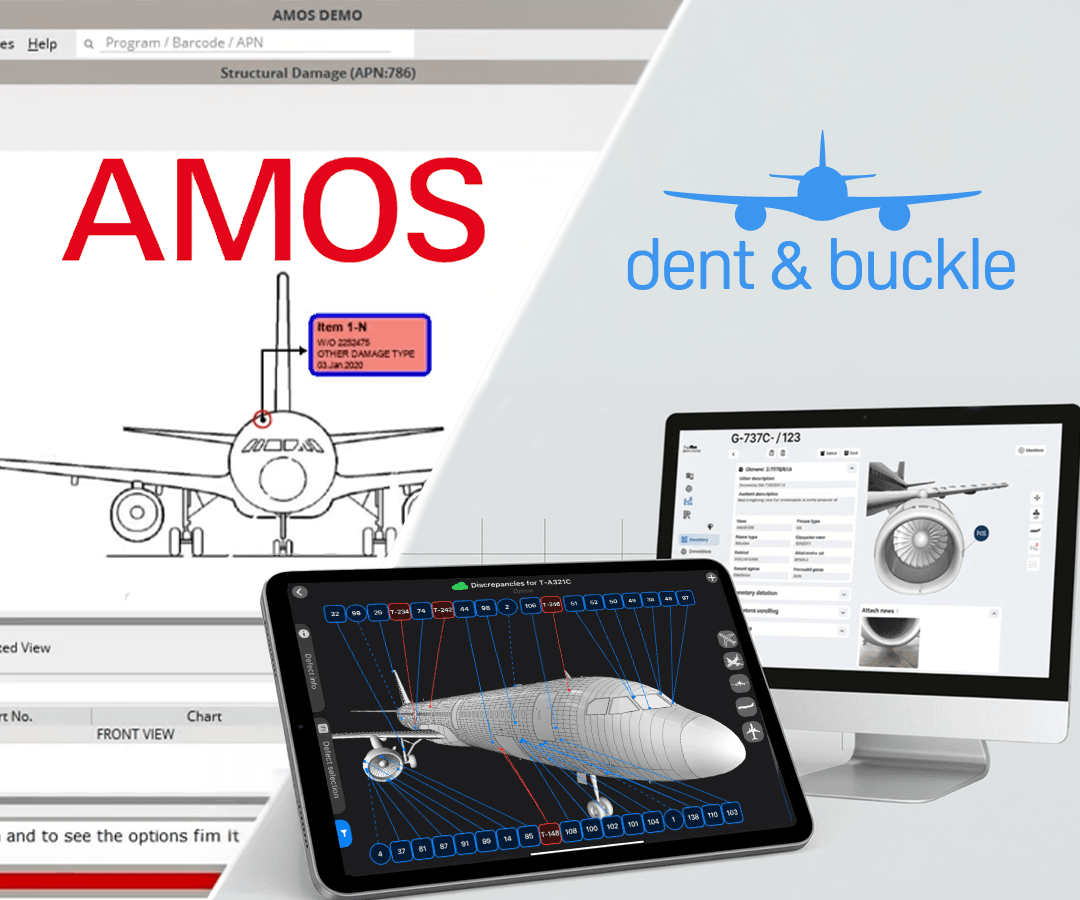
The most visible difference is the way damage is recorded. Instead of marking a flat two-dimensional chart, a mechanic places the damage on an interactive three-dimensional model of the specific aircraft, accurately and in a single tap. Operators who have made the switch describe it as a different category of tool altogether, with far richer classification and a quality of mapping that flat charting cannot match. Cleaner input at the source means cleaner records moving through the rest of your maintenance system.
It is also designed for where the work happens. The tool runs on any mobile device, whether a mechanic’s own phone or an engineer’s tablet, with no additional hardware and nothing to install. The damage is logged at the aircraft, not transcribed at a desk an hour later when detail has already been lost.
And as components move between aircraft, the structural and repair records move with them, so the history stays accurate as parts rotate through the fleet.
“But our MRO system already has a dent and buckle chart”
It does, and so do most of the major platforms. Native structural-damage charting is a standard feature of the leading MRO systems, AMOS included. The point is not that the feature is missing; it is that it was built as one capability among hundreds rather than as a discipline in its own right, and in daily use that difference shows.
Native modules still tend to lean on flat, two-dimensional charting rather than a true interactive 3D model, their damage classification is comparatively shallow, and the workflow is designed desk-first. Even where the wider MRO platform offers mobile access, that is general system access, not a purpose-built tool for capturing a dent quickly and precisely while standing at the aircraft. The native chart is perfectly adequate for recording that a damage exists. It is not built for the fast, accurate, on-the-ramp capture where the real time and cost are won or lost, and that is exactly the gap a dedicated system closes.
AMOS vs. Dent & Buckle
Five differences in structural defect reporting
A fair comparison starts with what each system is built for. AMOS is a full maintenance, engineering and logistics platform, and a superb one — but structural defect reporting is only a small corner of everything it has to carry. Dent & Buckle does that one job and nothing else, and that focus is exactly why it fills the gaps a general MRO module leaves open. For the specific task of finding, recording and evidencing structural damage, it is simply the better-fitted tool — and the difference shows in five places that matter on the line.
| For the job of structural defect reporting | Dent & Buckle — purpose-built for structural damage | AMOS — native structural charting inside a full MRO suite |
| 3D visualisation | Interactive, dimensionally accurate 3D models with frame and stringer detail; a defect is placed in a single tap, exactly where it sits relative to the structure — so finding the right SRM repair instructions takes far less time. | General-purpose, flatter 2D charting that was never designed for this kind of pinpoint structural context. |
| Mobile capture | A dedicated mobile app across iOS, Android and Windows that works online or offline; crews log new damage in one tap and stay synchronised in real time, right at the aircraft. | Has a mobile suite — but a broad one built to cover many maintenance tasks, not an offline structural-capture tool. |
| Live charts | One interactive chart kept synchronised live across every device, always showing the airframe as it is right now. | A chart that is printed or exported becomes a snapshot of the past the moment new damage occurs, opening the gap where confusion and AOG delays creep in. |
| Component intelligence | Component-based models: a defect stays attached to its part and travels with it automatically — on-wing or off-wing — when the component is removed, repaired or refitted elsewhere. | A general module isn’t designed to keep the visual structural record tied to a moving component. |
| Lease-return reporting | Comprehensive, item-by-item reports with full defect histories, images and attached documents — the depth of evidence that turns a months-long negotiation into a clean handover. | General charting isn’t built to produce specialist lease-return documentation to that standard. |
The common thread across all five is focus: none of this asks you to move off AMOS. Dent & Buckle is a separate system that runs on its own and, when you want it to, integrates with AMOS so every structural record your engineers capture flows straight into your MRO.
A separate system that works with AMOS, not against it
The case for Dent & Buckle is not that AMOS falls short. AMOS remains the system of record for the entire operation, and that is exactly where it should stay. The case is narrower and, for that reason, stronger: structural damage is a specialist discipline, and specialist disciplines reward purpose-built tools.
Dent & Buckle is a standalone system. It runs perfectly well on its own, and many operators use it that way. Where it adds even more value is when you choose to connect it to AMOS, so the clean, well-classified structural data your engineers capture flows straight into your MRO records. That integration is an option, not an obligation. Adopt the dedicated system first, prove its value on the line, and integrate with AMOS when and if it suits your operation. Either way, your teams gain specialist depth without disturbing the platform they already rely on.
The benefits land where airlines feel them most directly. Dent checks are faster and are captured the first time correctly. Damage can be recorded in 30 seconds instead of several minutes. Structural records arrive audit-ready and lease-return-ready, breaking the re-assessment cycle. Inspection time and AOG exposure fall. And the fleet keeps a single, reliable structural history rather than one scattered across disconnected files.
Operators are already pairing the two
A growing number of maintenance organisations are taking precisely this approach: AMOS as the core, with a dedicated structural system running alongside it, connected where integration helps. The early feedback is the kind every engineering department hopes for, namely quicker capture on the line, tidier records and fewer surprises at lease return.
If your engineers are still mapping dents on paper, on a flat chart, or across three disconnected tools, time and money are being left on the ramp. A short demonstration on your own aircraft types is the quickest way to see how a dedicated structural system turns a strong AMOS operation into a faster, audit-ready one.