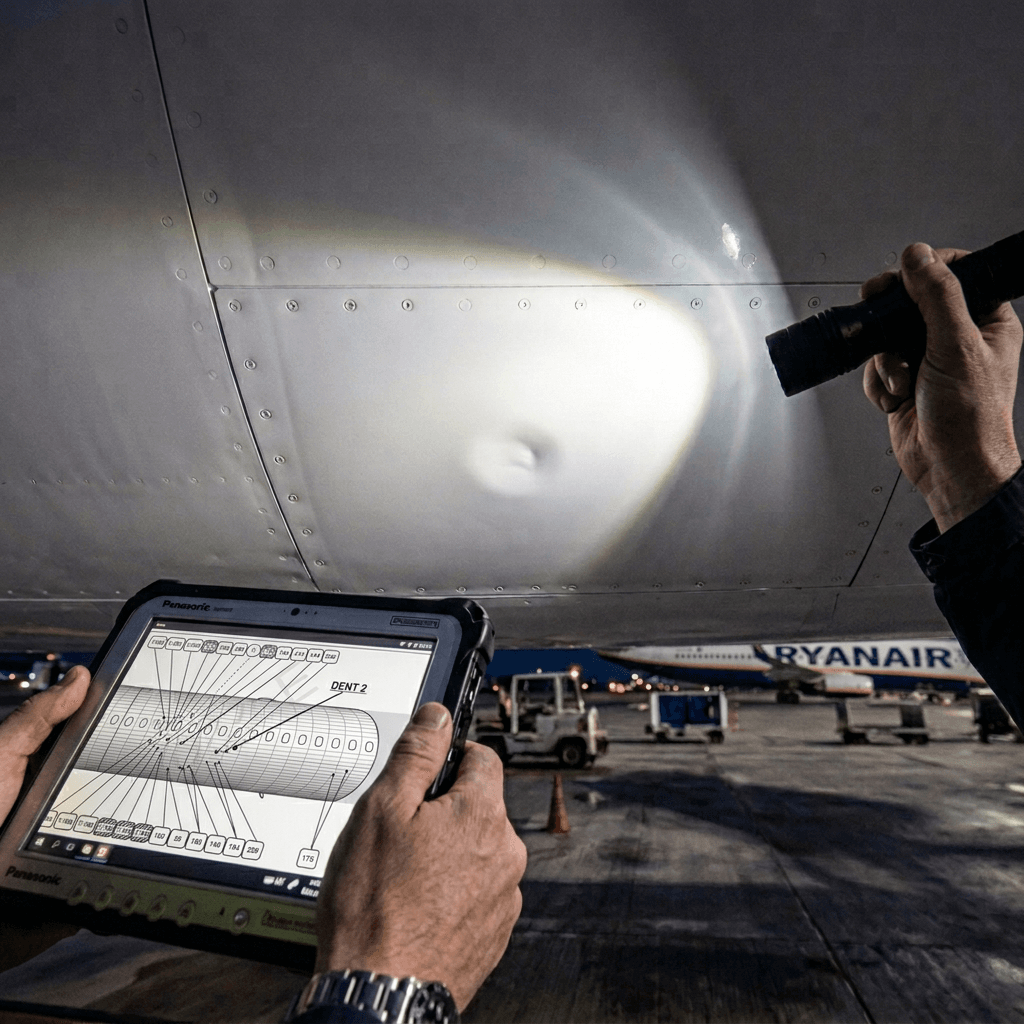

A Gulfstream G650 sits on the ramp at Van Nuys. The client—a Fortune 500 CEO—expects wheels-up in three hours for a critical acquisition meeting in Dubai. During the walk-around, your lead technician notices a small impression on the aft fuselage panel, about the size of a quarter.
Now comes the expensive part.
Someone needs to determine if this dent existed before. Was it documented? What’s its history? Is it within tolerance, or does it ground a $65 million aircraft and torch a client relationship worth seven figures annually?
In most business aviation operations, answering these questions means diving into a chaos of paperwork, outdated spreadsheets, and institutional knowledge that lives exclusively in Frank’s head—and Frank’s on vacation in Costa Rica.
This isn’t a maintenance problem. It’s a business continuity crisis disguised as a technical question.
The Paper Trail Problem nobody talks about
Business jet operators exist in a perpetual state of controlled urgency. Unlike commercial aviation with its predictable schedules and standardized procedures, your world involves last-minute repositioning flights, demanding clients who expect perfection, and operational windows measured in hours, not days.
Yet most operators still manage structural defects using methods that predate the iPhone. Paper logbooks, flat 2D diagrams that barely resemble actual aircraft geometry, and records that are scattered across multiple systems that have never met, let alone been integrated.
The consequences show up in your Profit & Loss statement, even if they’re not labeled as “defect management costs.”
There’s the cancelled charter because nobody could definitively answer whether that panel dent needed immediate attention. The extended downtime during pre-purchase inspections was due to assembling a complete defect history that took three weeks instead of three minutes. The lease return nightmare that consumed countless hours compiling documentation that should have been instantly accessible.
Every business jet operation bleeds money this way. Most just accept it as the cost of doing business.
When Flat Drawings Meet 3D Reality
Traditional defect charts operate in two dimensions. Your aircraft exists in three.
This gap creates constant translation errors that waste time and introduce risk. When a previous technician noted “dent on left side, Station 580, 15 inches from stringer,” they’ve left you a treasure hunt, not documentation. Which 15 inches? At what angle? Measured from which reference point on a curved surface?
Engineers compensate by developing their own mental maps of each aircraft. This works brilliantly until that engineer leaves, retires, or simply isn’t available when you need an answer immediately.
For fleet operators managing multiple Challengers, Citations, and Phenoms—each with different panel configurations and structural layouts—this knowledge fragmentation worsens exponentially. Your operational capability becomes hostage to individual memory rather than institutional systems.
The 3D Difference, precision that matters
Dent & Buckle rebuilt defect management from the ground up around one principle: your documentation should match the dimensional reality of your aircraft.
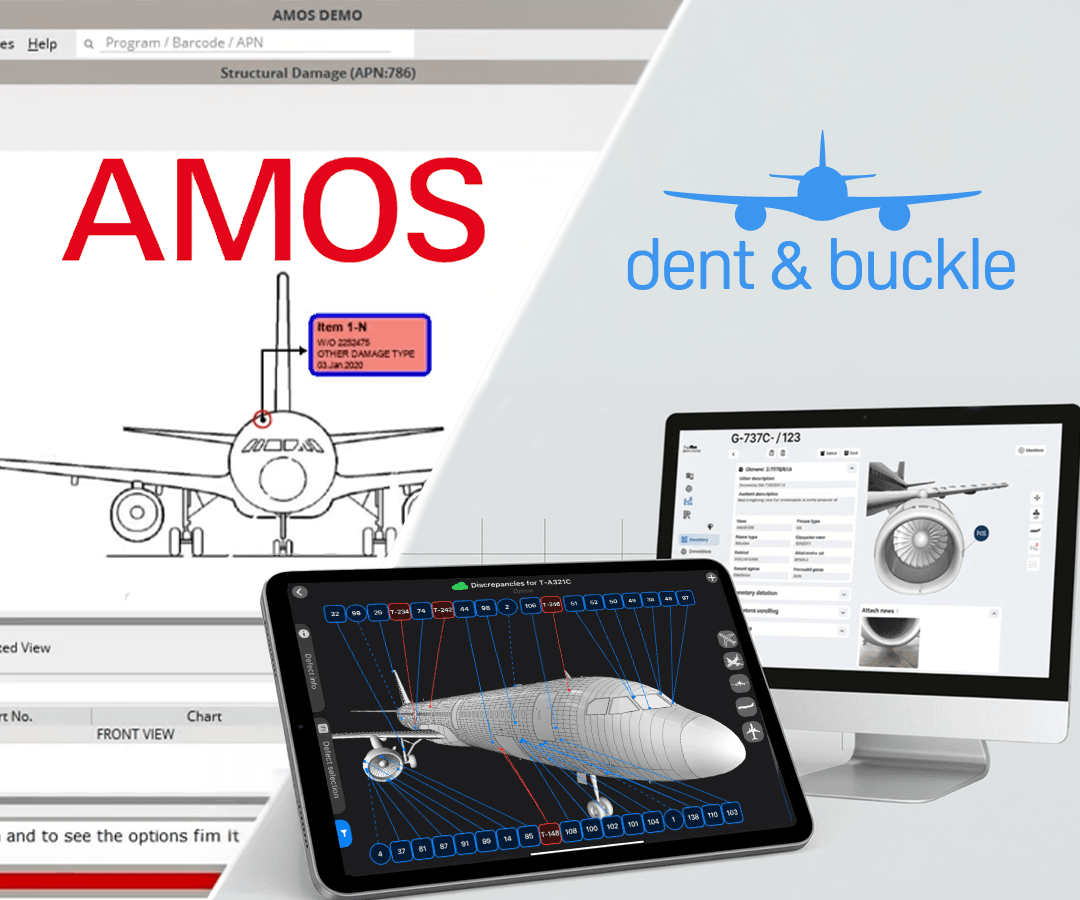
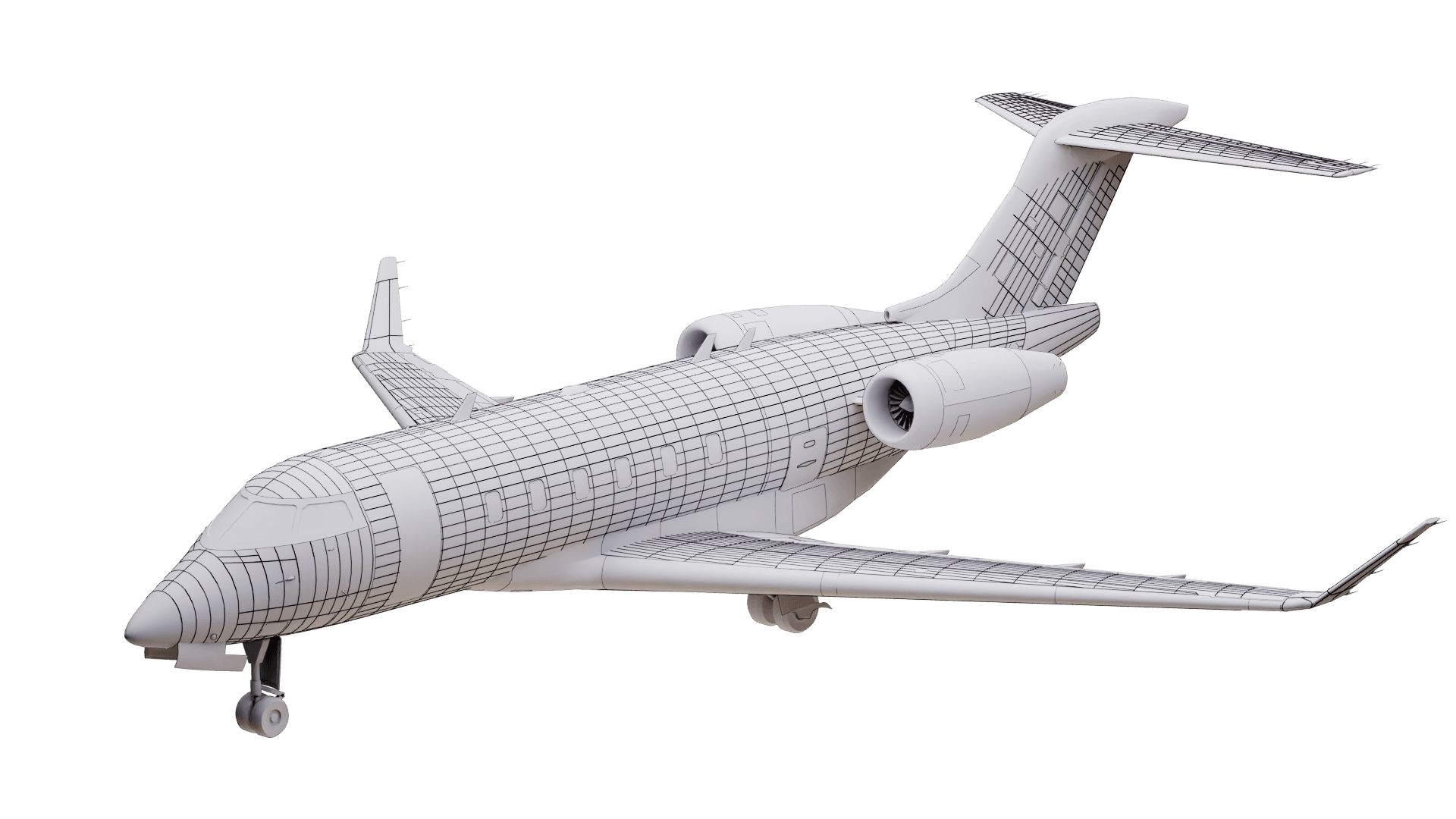
Our platform replaces ambiguous descriptions with accurate locations on interactive 3D jet models. When a technician documents a defect, they’re pinpointing it on a digital representation that mirrors the actual aircraft geometry. No interpretation required, no translation errors, no guesswork about whether this is the same dent someone mentioned six months ago.
But here’s what separates this from just “fancy graphics”—the intelligence built into the system.
These aren’t static 3D pictures. They’re component-based models where every panel, every structural element maintains its own identity. When you swap components during refurbishment or move panels between aircraft in your fleet, the associated defect records follow automatically. The system understands that Panel 47B has a history, regardless of which airframe it’s currently installed on.
For business jet operators who frequently upgrade interiors, reconfigure cabins, or exchange components to minimize downtime, this intelligence prevents defect histories from disappearing into documentation gaps.
The Business Aviation Speed Requirement
Your clients didn’t choose business aviation for the scenic route. They’re buying time, flexibility, and reliability. When a structural question grounds an aircraft, you’re not just facing maintenance costs—you’re risking the relationship that justifies your entire operation.
Dent & Buckle’s mobile-first approach acknowledges this reality, it enables technicians to document defects in real-time using tablets or phones, whether they’re in a climate-controlled hangar or on a windswept ramp in Teterboro with intermittent connectivity. The application works offline and syncs automatically when the connection returns.
This matters because business jets don’t respect your office hours. When an issue surfaces at 11 PM at an unfamiliar fixed-base operator, your team needs immediate access to complete defect histories, not a promise to “check the files tomorrow.”
The platform handles the full lifecycle—from initial discovery through documentation, tracking, repair, and eventually generating comprehensive reports for lease returns or pre-purchase inspections. What traditionally consumed weeks of administrative labor now takes minutes.
Integration (Because you already have systems)
No business aviation operation runs on a single system. You’ve got MRO software, digital tech logs, document management, possibly scheduling, and charter management platforms. Any new solution that demands you abandon this infrastructure is dead on arrival.
Dent & Buckle integrates with existing MRO systems, treating itself as a specialized component of your technology ecosystem rather than a replacement for everything you’ve built. The platform connects with tech logs, document management systems, and increasingly relevant technologies like surface scanning and drone inspection capabilities.
This open architecture means you’re enhancing your operation, not rebuilding it from scratch.
What the Numbers Actually Tell You
The platform claims to reduce defect management time by at least 50%. For a mid-sized business jet operator managing ten aircraft, this translates directly into recovered technician hours, faster turnarounds, and reduced administrative overhead.
But the financial impact extends beyond simple time savings.
Consider lease returns. The traditional process involves manually compiling defect records, cross-referencing maintenance logs, and assembling documentation packages that satisfy lessors and prospective buyers. This typically consumes 40-80 hours of skilled labor per aircraft. With digital 3D defect management, operators can generate complete aircraft defect reports in minutes.
At a loaded labor cost of $85/hour for qualified technicians, that’s $3,400-$6,800 in direct savings per lease return. Multiply across a fleet, and you’re looking at five-figure annual recoveries just from this single use case.
Then there’s the avoided cost of operational disruptions. When you can instantly answer structural questions with certainty, you make better decisions faster. Aircraft stay in service when they should. Maintenance gets scheduled proactively instead of reactively. Client relationships remain intact because you’re never caught flat-footed by questions about aircraft condition.
This Matters Now
The business aviation market has evolved dramatically. Clients expect the same digital sophistication they experience in every other aspect of their professional lives. Proving aircraft condition for insurance, financing, or sales increasingly requires more than a stack of paper records and a handshake.
Meanwhile, regulatory scrutiny around maintenance documentation continues to intensify. Auditors want clear, consistent records that demonstrate structural integrity over time. Try explaining to a CAA inspector why your defect locations are described using terms like “approximate” and “roughly.”
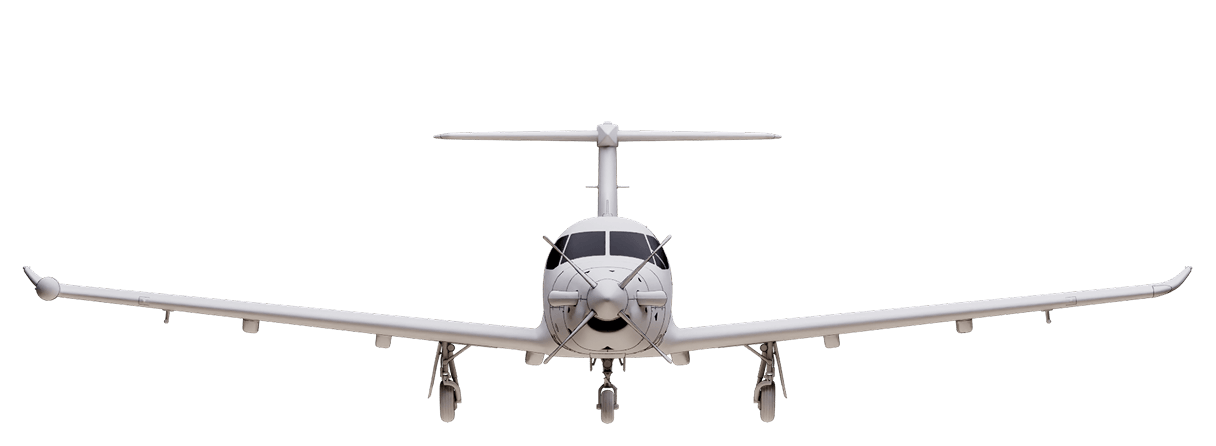
Dent & Buckle supports 30+ aircraft types and 70+ variants, covering the diversity typical in business aviation fleets. Whether you operate Bombardier Globals, Gulfstream G-series, Cessna Citations, or Embraer Phenoms, the platform adapts to your specific fleet composition.
________________________________________________________________________________________________________________________